
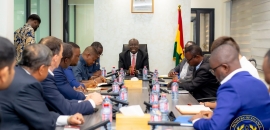
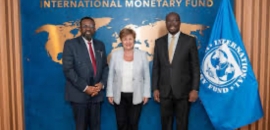
Ato Forson Welcomes IMF Review Team
Sep 30, 2025
by Ekow Benyah Jan 17, 2026
The International Monetary Fund (IMF) has reaffirmed its assessment that Ghana’s Gold Board (GoldBod) incurred losses of approximately US$214 million, maintaining that its position on the matter remains unchanged despite public debate.
The loss figure was first outlined in the IMF’s Staff Report for the Fifth Review of Ghana’s IMF-supported economic programme and has since attracted widespread discussion regarding its implications for the country’s fiscal health.
Addressing questions at a press briefing on Thursday, January 15, 2026, IMF Director of Communications Julie Kozack said the Fund had already provided detailed clarification on the issue and stood firmly by its analysis.
According to her, although the domestic gold purchase programme linked to GoldBod delivered important economic benefits, it also resulted in significant quasi-fiscal losses for the state.
“On the benefit side, what we see is a contribution to a buildup of international reserves and reduced pressure on the foreign exchange market during a difficult period for Ghana,” Kozack explained.
However, she noted that the programme also came with notable financial costs.
“The report quantified what we call a quasi-fiscal loss, meaning it is not on the fiscal balance sheet, but ultimately it is a fiscal loss. And that loss was $214 million,” she stated.
Kozack attributed the losses to trading activities, associated fees, and exchange rate movements, stressing that although the losses are not currently reflected in government accounts, they still represent a financial burden on the state.
To address the situation, the IMF has recommended stronger transparency, governance, and risk management measures, particularly in operations linked to GoldBod under the domestic gold purchase initiative.
The Fund also urged the government to formally recognise such losses on the national fiscal balance sheet rather than leaving them on the books of the Bank of Ghana.
“We strongly recommend that the losses should be brought on balance sheet rather than held on the balance sheet of the Central Bank. This is important to ensure that the Bank of Ghana remains well,” Kozack said.
Meanwhile, the IMF has expressed strong confidence in Ghana’s economic performance in 2025, describing progress under the Fund-supported programme as encouraging.
IMF Resident Representative in Ghana, Dr Adrian Alter, said the economy has performed better than many analysts expected, dismissing suggestions that recent gains were exaggerated or artificially driven by IMF support.
“Ghana’s programme remains solid and on track, with the fifth review completed and disbursement made at the end of December,” Dr Alter stated.
According to the IMF, key macroeconomic indicators including inflation control, currency stability, and fiscal consolidation have shown significant improvement, reflecting the impact of ongoing economic reforms.
The Fund has therefore maintained a cautiously optimistic outlook on Ghana’s economic recovery, while reiterating the need for continued discipline, accountability, and transparency in the management of public resources.

Sep 30, 2025

Oct 16, 2025
May 23, 2026
Jan 17, 2026
Oct 05, 2025
Feb 20, 2026

Sep 16, 2025
Sep 15, 2025
